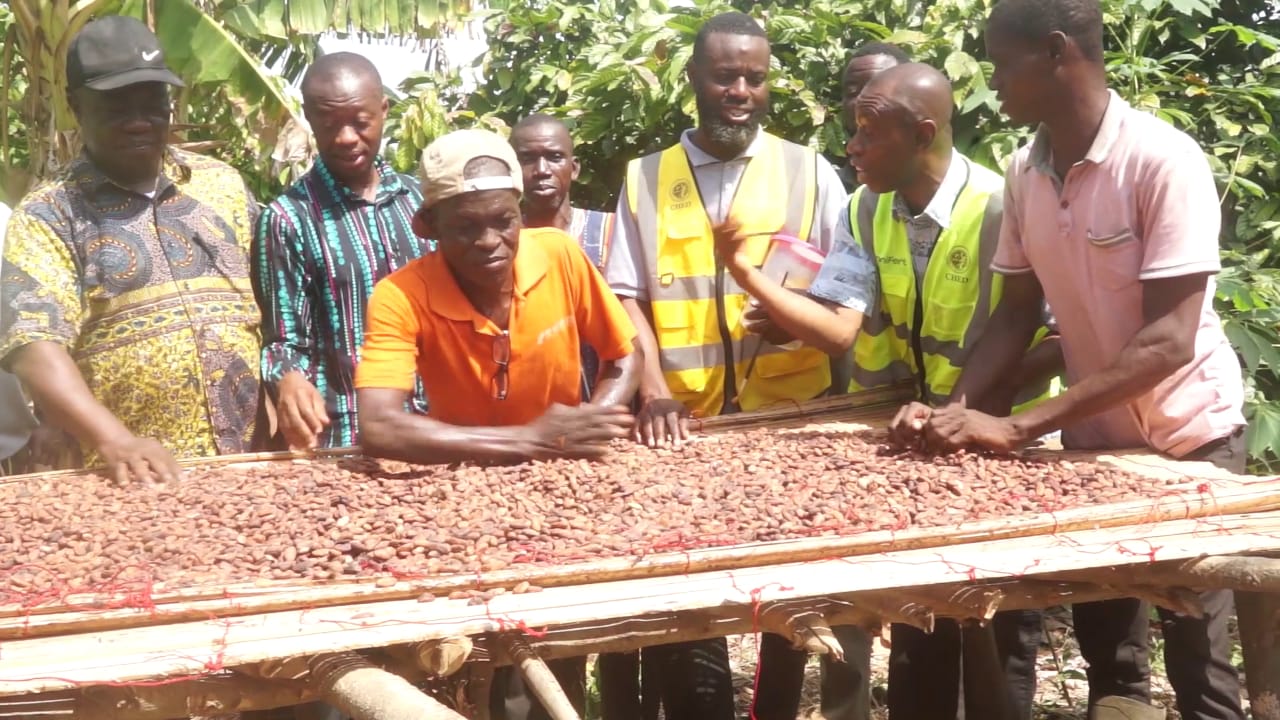
Against all expectations, a determined farmer from the Northern Region, Mohammed Anchela, has challenged and overturned the long-standing belief that cocoa cannot survive in the northern savannah belt.
For decades, agricultural experts and local residents maintained that the region’s dry climate, shorter rainy season, and high temperatures made cocoa cultivation nearly impossible.
Farmers in Nanumba North and surrounding areas had grown accustomed to cultivating drought-resistant crops such as yam, maize, millet, and groundnuts, leaving cocoa exclusively to the forested southern parts of Ghana.
Get the latest news, updates by joining our WhatsApp channel here: Join on WhatsApp.
Yet, in 2012, driven by strong conviction and guided by innovation, Mohammed Anchela decided to plant cocoa in the northern region, confident that with dedication and proper care, the crop could thrive even in an unexpected environment.
His decision to establish a cocoa farm in Salnaa Yili in the Nanumba North Municipality was initially met with widespread skepticism and even mockery.
Many residents believed the venture was a waste of time and resources, arguing that the harsh climatic conditions would not permit cocoa seedlings to survive.
But Anchela remained undeterred. He adopted improved agronomic practices, selected resilient hybrid cocoa varieties, and committed himself to nurturing the young plants. Over the years, the farm gradually transformed into a small but thriving cocoa grove.
The early stages were particularly challenging due to irregular rainfall patterns and the constant need for extra care. Despite the difficulties, Anchela persevered.
His farm soon became a point of curiosity, attracting fellow farmers who visited to witness what they once believed to be impossible.
To their amazement, the cocoa trees were not only surviving but flourishing. Inspired by his resilience, several farmers, including peasant farmer Jegri Abukari, expressed readiness to venture into cocoa cultivation.
Today, Mohammed Anchela’s remarkable achievement stands as a powerful testament to innovation, resilience, and the courage to defy the odds.
His success has sparked fresh conversations about agricultural diversification in the northern region and reduced dependency on traditional crops.
It was this extraordinary accomplishment that drew the attention of the Ghana Cocoa Board, prompting a high-level delegation to visit Salnaa Yili.
Led by the Deputy Chief Executive Officer of COCOBOD, the team toured the farm to assess its progress. After an extensive inspection, the officials could not hide their admiration for the farmer’s ingenuity and determination.
During the visit, Mohammed Anchela explained that although many doubted the feasibility of growing cocoa in the north, he remained convinced that it was achievable.
A retired Agric Officer, Ali Dasana, also praised the pioneering farmer. He noted that for many years, both farmers and agricultural experts believed the northern environment was unsuitable for cocoa cultivation.
However, he emphasized that Anchela’s success has disproved this long-held perception and opened new possibilities for the region.
In recognition of his groundbreaking work, the Deputy CEO of COCOBOD, Dr. Francis Baah, announced that the CEO of COCOBOD, Dr. Randy Abbey, has pledged to build a house for Mohammed Anchela.
Dr. Baah further commended the farmer for his exceptional innovation and urged residents to desist from indiscriminate bush burning, which continues to pose a threat to farmlands and pioneering efforts such as this.