The Ghana Navy has successfully disrupted a large-scale illegal fuel bunkering operation along the Keta-Denu-Aflao coastline in the Volta Region, reinforcing its resolve to protect Ghana‘s maritime domain from transnational crime.
The operation, which took place on Thursday, January 15, 2026, was carried out during an intelligence-led maritime security patrol by sailors onboard a Ghana Navy ship.
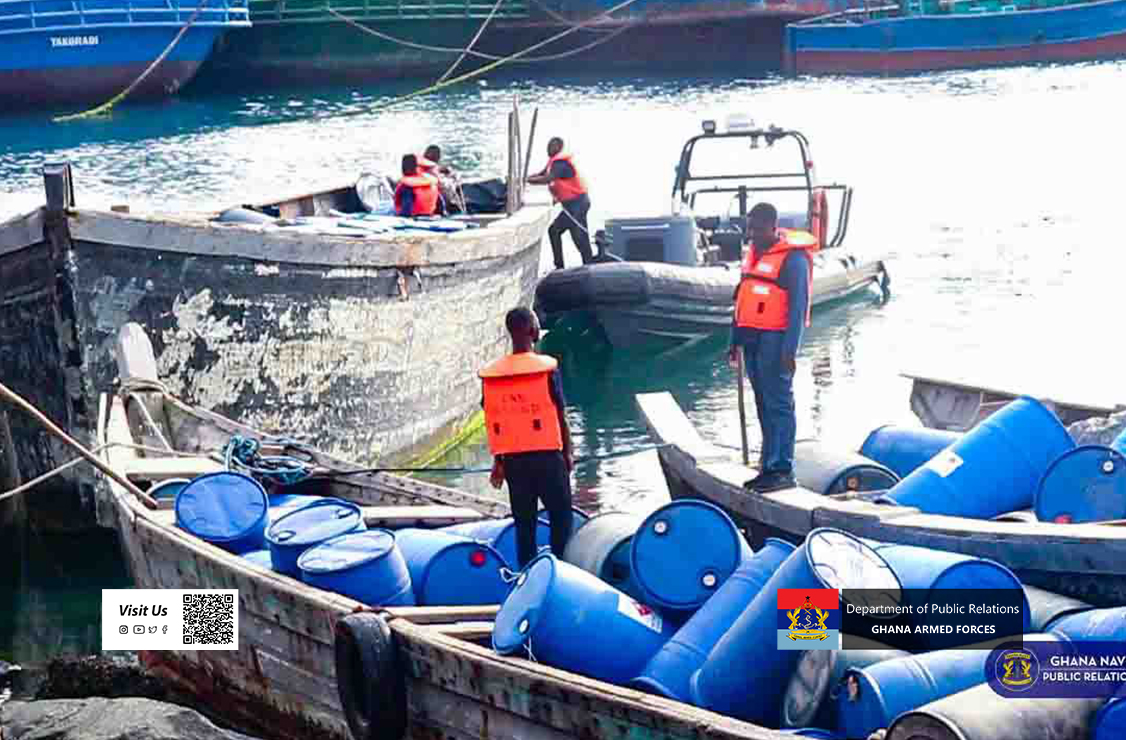
The patrol intercepted seven specially modified canoes, locally known as “Dendes”, suspected to be used for illicit fuel bunkering activities at sea.
Get the latest news, updates by joining our WhatsApp channel here: Join on WhatsApp.
Addressing the media at the Eastern Naval Command (ENC), the Flag Officer Commanding, Commodore Solomon Asiedu-Larbi, disclosed that the intercepted canoes contained approximately 378 empty barrels, clearly designed for large-scale fuel smuggling.
He noted that the design and capacity of the canoes strongly indicated their involvement in organised illegal bunkering operations.
Commodore Asiedu-Larbi commended the naval personnel for their vigilance and professionalism, stressing that the Ghana Navy remains firm in combating illegal fuel bunkering, unlawful fishing, smuggling, and other maritime crimes that threaten national security and economic stability.
He further revealed that, under the direction of the Chief of the Naval Staff, Rear Admiral Godwin Livinus Bessing, additional maritime assets are being deployed to strengthen surveillance and improve rapid response capabilities along the Eastern maritime corridor.
Providing further details, the ENC Command Operations Officer, Commander James Dzigbordzi Agrah, explained that the suspects fled upon sighting the Navy vessel, abandoning the canoes, which were subsequently seized and towed to harbour.
He outlined how fuel bunkering syndicates typically operate, with larger “mother vessels” offshore transferring stolen fuel to smaller canoes for onward smuggling to coastal landing sites.
Commander Agrah warned that such activities lead to significant revenue losses through tax evasion, introduce adulterated fuel into local markets, and cause environmental pollution, posing serious risks to marine ecosystems and fish populations.
The Eastern Naval Command has announced enhanced countermeasures, including intensified community engagement, the deployment of unmanned aerial systems, and closer collaboration with maritime stakeholders to dismantle fuel bunkering networks.
The Ghana Navy has urged coastal communities to report suspicious maritime activities, emphasizing that public cooperation is critical to safeguarding national security, protecting marine biodiversity, and sustaining Ghana’s blue economy.