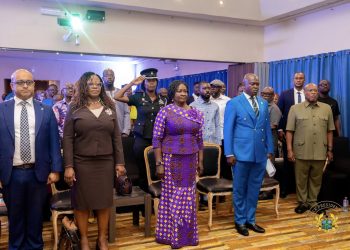
A serene, reflective atmosphere is expected to envelop Black Star Square on Friday as Ghanaians from every corner of society gather to honour the life and legacy of the country’s longest-serving First Lady, Nana Konadu Agyeman-Rawlings.
Final preparations were completed on Thursday, November 27, with security agencies and State protocol teams coordinating to ensure a dignified ceremony befitting her national stature and royal lineage.
The State Funeral is scheduled to begin at 8:00 a.m., drawing top government officials, diplomats, parliamentarians, traditional leaders, gender advocates, clergy, and scores of mourners.
Get the latest news, updates by joining our WhatsApp channel here: Join on WhatsApp.
A solemn Requiem Mass was held on Wednesday at the Accra Ridge Church, where prayers and tributes highlighted her enduring impact on national development. Her family has expressed deep gratitude to the public for the overwhelming support since her passing on October 23, 2025.
Nana Konadu, Founder of the 31st December Women’s Movement, leaves behind a formidable legacy as a pioneering advocate for women’s empowerment.
Tributes have described her as “a national treasure,” “an indomitable spirit,” and “a beacon of women’s empowerment.” Among the condolences was a message from Switzerland’s Ambassador to Ghana, Madam Simone Giger, who praised her unwavering dedication to advancing women’s rights.
Beyond public service, she was celebrated for her elegance, expressive love for fashion, music, dance, and the arts, attributes that cemented her as a symbol of cultural confidence and pride.
Born on November 17, 1948, in Cape Coast to J.O.T. and Felicia Agyeman, she was raised within a tradition of discipline, leadership and ambition.
Her education journey took her through Achimota School; the Kwame Nkrumah University of Science and Technology, where she studied Textile Design and rose to become SRC Secretary; and further advanced studies in interior design, personnel management, development, and policy at leading institutions in Ghana, the UK and the U.S.
Her professional background included work with Union Trading Company and Nanali Africarts, before founding the 31st December Women’s Movement—an organisation that played a crucial role in improving the socio-economic lives of women nationwide.
In 1977, she married Jerry John Rawlings, then a young Air Force Officer who would later become Head of State and President. Their marriage, blessed with four children—Zanetor, Yaa Asantewaa, Amina and Kimathi—became one of the most influential partnerships in Ghana’s political history.
As the nation prepares for her final farewell, the mood is one of deep respect for a woman whose life shaped policy, empowered generations, and transformed the national conversation on gender equality. The Deputy Chief of Staff has called on government institutions, civil society, private sector players and philanthropic organisations to urgently strengthen domestic resource mobilisation to secure Ghana’s long-term development and reduce dependence on shrinking donor assistance.
Speaking at the opening of the 2025 Ghana Philanthropy Conference (GPC25) in Accra, she warned that continued reliance on unpredictable external aid was no longer sustainable.
Ghana, she said, must “look inward” and forge stronger, better-aligned partnerships that allow national development programmes to thrive without being derailed by global funding uncertainties.
She commended STAR–Ghana Foundation for sustaining civil society efforts through coordinated local resource mobilisation, describing domestic financing as “the single most important determinant” of Ghana’s fiscal independence at a time of tightening global economic conditions.
According to her, broadening the revenue base, plugging leakages and strengthening legal and policy frameworks would enable local philanthropy, impact investment and innovative financing to flourish.
Madam Addo outlined the government’s use of domestic resources to advance inclusive development through initiatives such as continued support for Free SHS, free tertiary education for persons with disabilities, removal of registration fees for first-year students and major youth empowerment programmes, including Ejumapa and the One Million Coders Project.
She further disclosed the Cabinet’s approval of a Governance Advisory Council and the initiation of processes toward a National Philanthropy Bill, committing to champion an enabling ecosystem for philanthropic growth.
Alex Mould, CEO of the Millennium Development Authority (MiDA), said Ghana’s challenge was not a shortage of capable organisations or ideas but a lack of coordination.
With adequate accountability systems, he noted, catalytic capital could scale locally proven innovations into impactful national programmes.

Alhaji Ibrahim-Tanko Amidu, Executive Director of STAR–Ghana Foundation, described GPC25 as a unified platform that replaces fragmented philanthropic engagements.
He stressed that partnerships among government, civil society, private sector and donors were essential, warning against pursuing domestic resource mobilisation merely as a reaction to shrinking aid.
Sustainable development, he argued, required long-term national ownership rather than dependence on short-term donor cycles.
Dr Stigmata Tenga, Executive Director of the African Philanthropy Network (APN), said the reduction of donor funding should be seen as an opportunity for African countries to elevate domestic and community philanthropy as drivers of inclusive, locally led development.
Governments, she added, must treat philanthropy as a strategic component of national planning, not an ad hoc supplement.
Stakeholders at the conference agreed that Ghana’s greatest potential lies in leveraging its longstanding traditions of giving, mutual aid and community solidarity.
However, these contributions remain largely uncoordinated and undocumented.
They called for a national philanthropic ecosystem supported by digital tools, strong accountability, tax incentives, diaspora engagement and partnerships across the public, private and civil society sectors.